

Schedule 80 (SCH 80) Meaning the Schedule (SCH number) is a dimensionless value used in ASME B36.10M/B36.19M standards to define the wall thickness grade of steel pipes. It is not a material grade, nor does it represent a fixed number of millimeters. For the same SCH value, different nominal pipe diameters (NPS) correspond to different actual wall thicknesses because the wall thickness is derived from a table lookup related to the outer diameter (OD).
SCH 80 belongs to the Extra Strong/XS range and is commonly used in medium and high pressure systems. For NPS ≤ 10", the wall thickness of SCH 80 is consistent with XS (Extra Strong); for values exceeding this range, a separate value is taken from the standard table.
Schedule 80 Pipe Thickness
The following is a cross-reference table of wall thickness sizes for Schedule 80 carbon steel pipe:
Common sizes:
NPS 1/2″: wall thickness 3.73mm
NPS 1″: wall thickness 4.55mm
NPS 4″: wall thickness 8.56mm
Special sizes are:
NPS 3″: outside diameter 88.9mm, wall thickness 7.62mm (0.300 inches)
NPS 6″: outside diameter 168.3mm, wall thickness 10.97mm (0.432 inches)
SCH 80 Carbon Steel Pipe Dimensions and Wall Thickness
Complete Data Sheet (mm) The table below is based on ASME B36.10M standard. All dimensions are given in millimeters (mm) and kilograms per meter (kg/m). ID (inner diameter) = OD − 2 × wall thickness.
| NPS (DN) | Outside Diameter, | Outside Diameter, | Wall Thickness | Wall Thickness | Plain End | Plain End |
| (mm) | (inch) | (mm) | (inch) | Weight (Mass) | Weight (Mass) | |
| (Ib/ft) | (kg/m) | |||||
| 1/8(6) | 10.29 | 0.405 | 2.41 | 0.095 | 0.24 | 0.37 |
| 1/4(8) | 13.72 | 0.54 | 3.02 | 0.119 | 0.43 | 0.63 |
| 3/8(10) | 17.14 | 0.675 | 3.2 | 0.126 | 0.57 | 0.84 |
| 1/2(15) | 21.34 | 0.84 | 3.73 | 0.147 | 0.85 | 1.27 |
| 3/4(20) | 26.67 | 1.05 | 3.91 | 0.154 | 1.13 | 1.68 |
| 1(25) | 33.4 | 1.315 | 4.55 | 0.179 | 1.68 | 2.5 |
| 1 1/4 (32) | 42.16 | 1.66 | 4.85 | 0.191 | 2.27 | 3.39 |
| 1 1/2 (40) | 48.26 | 1.9 | 5.08 | 0.2 | 2.72 | 4.05 |
| 2(50) | 60.32 | 2.375 | 5.54 | 0.218 | 3.66 | 5.44 |
| 2 1/2(65) | 73.02 | 2.875 | 7.01 | 0.276 | 5.8 | 8.64 |
| 3(80) | 88.9 | 3.5 | 7.62 | 0.3 | 7.58 | 11.29 |
| 3 1/2(90) | 101.6 | 4 | 8.08 | 0.318 | 9.12 | 13.57 |
| 4(100) | 114.3 | 4.5 | 8.56 | 0.337 | 10.8 | 16.08 |
| 5(125) | 141.3 | 5.563 | 9.52 | 0.375 | 14.63 | 21.77 |
| 6(150) | 168.28 | 6.625 | 10.97 | 0.432 | 18.99 | 28.26 |
| 8(200) | 219.08 | 8.625 | 12.7 | 0.5 | 28.58 | 42.55 |
| 10(250) | 273 | 10.75 | 12.7 | 0.5 | 40.52 | 60.29 |
| 12(300) | 323.8 | 12.75 | 12.7 | 0.5 | 49.61 | 73.79 |
| 14(350) | 355.6 | 14 | 12.7 | 0.5 | 54.62 | 81.25 |
| 16(400) | 406.4 | 16 | 12.7 | 0.5 | 62.64 | 93.18 |
| 18(450) | 457.2 | 18 | 12.7 | 0.5 | 70.65 | 105.17 |
| 20(500) | 508 | 20 | 12.7 | 0.5 | 78.67 | 117.03 |
| 22(550) | 558.8 | 22 | ... | ... | ... | ... |
| 24(600) | 609.6 | 24 | 12.7 | 0.5 | 94.71 | 140.89 |
| 30(750) | 762 | 30 | ... | ... | ... | ... |
SCH 80 Pipe Thickness
SCH 80 pipe features a relatively thick wall, making it suitable for applications that require higher pressure resistance and enhanced mechanical strength. For example, a 1-inch (DN25) SCH 80 pipe has a wall thickness of approximately 4.55 mm, while a 4-inch (DN100) pipe has a wall thickness of about 8.56 mm. A 6-inch (DN150) SCH 80 pipe typically features a wall thickness of 10.97 mm. Due to its robust construction.
SCH 80 Pipe Pressure Rating
Because SCH 80 pipe has thicker walls, it generally supports higher working pressures than SCH 40 pipe.
However, pressure ratings depend on several factors:
Material grade
Pipe size
Operating temperature
Design code
Corrosion allowance
Therefore, engineers should always verify pressure calculations according to ASME B31.3, ASME B31.1, or applicable project standards.
Pressure Rating by Pipe Size (ASTM A53 Grade B, Room Temperature)
| NPS | Wall (in) | Max Pressure (PSI) | Max Pressure (bar) |
| 1/2″ | 0.147 | ~8,575 | ~591 |
| 3/4″ | 0.154 | ~7,187 | ~496 |
| 1″ | 0.179 | ~6,670 | ~460 |
| 2″ | 0.218 | ~4,498 | ~310 |
| 3″ | 0.3 | ~4,200 | ~290 |
| 4″ | 0.337 | ~3,670 | ~253 |
| 6″ | 0.432 | ~3,195 | ~220 |
| 8″ | 0.5 | ~2,841 | ~196 |
What standards cover SCH 80 pipe dimensions?
ASME B36.10M covers carbon steel pipe dimensions, while ASME B36.19M covers stainless steel pipe dimensions.
How to choose the SCH 80 size?
1. The outer diameter is always determined by the NPS/DN, not the SCH—don't treat OD as a variable to "make do".
2. SCH 80 ≠ fixed mm: 2" pipe has a wall thickness of 5.54 mm, 8" pipe has 12.70 mm, and 24" pipe has 30.96 mm—never rely on experience to "guess" a uniform thickness.
3. Flow capacity will decrease: smaller ID → higher flow velocity at the same flow rate → pump power consumption/pressure drop needs to be verified.
Weight affects support spacing and civil engineering load: especially for large diameters ≥8″, the weight of SCH 80 almost doubles, requiring modifications to supports, pipe racks, and foundations.
4. The final design pressure must be calculated according to the specifications: SCH 80 is only a "wall thickness grade". The actual MAWP (maximum allowable working pressure) depends on the allowable stress of the material + temperature + weld joint coefficient + corrosion allowance. It should be calculated and checked according to ASME B31.3 / B31.1, etc., rather than relying solely on SCH to determine safety.
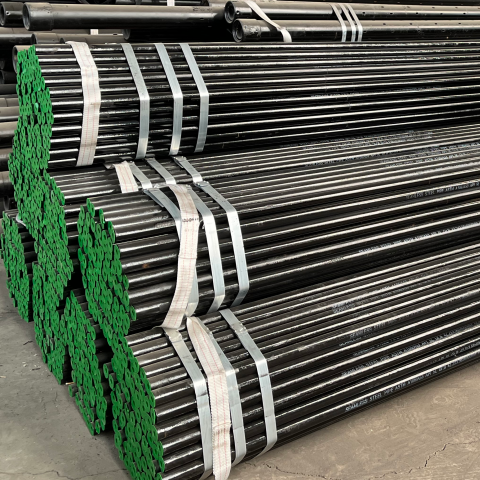
SCH 80 pipe is widely used in demanding industrial environments. It is available in a variety of materials, including carbon steel grades such as ASTM A106 Grade B and ASTM A53 Grade B, stainless steel grades like 304 and 316, alloy steel, and PVC for corrosion-resistant applications Email : pipe@stpipefitting.cn.
 Cold Rolled Seamless Steel Pipe
 What Is The Difference Between Stainless Steel 304 VS 201?
 Mechanical Tube Size Chart
 ASTM A106 Seamless carbon steel pipe

