

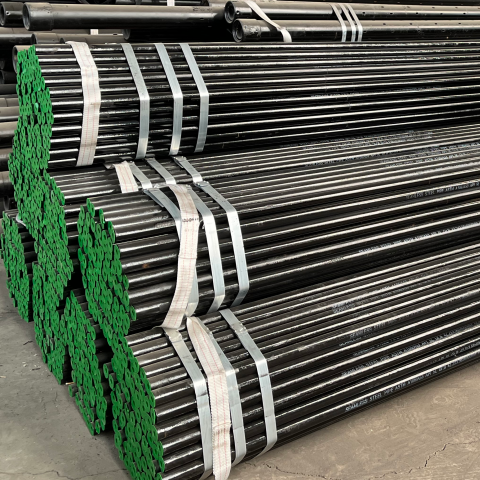
Mechanical pipes & tubes are steel tubes specially used in industrial fields such as machinery manufacturing, equipment structure, transmission system, etc., with the characteristics of high precision, high strength, wear resistance and pressure resistance. It is different from ordinary construction steel tubes or decorative tubes, and must meet strict dimensional tolerances, material properties and process requirements.
Definition:
It refers to seamless tubes or welded steel tubes used for mechanical structures, hydraulic systems, bearings, shafts and other components, which must meet specific mechanical properties and processing accuracy.
Core features:
High precision: small tolerances for outer diameter and wall thickness (such as ±0.05mm), strict requirements for roundness and straightness.
High strength: The material is mostly carbon steel (A519), alloy steel (such as 40Cr) or stainless steel (such as 304).
Process optimization: Improve surface finish (Ra≤0.8μm) and mechanical properties through processes such as cold drawing, cold rolling and heat treatment.
Main types of mechanical steel pipes:
1. Classification by use
Structural steel pipes: used for mechanical frames, transmission shafts, and supports.
Main standards: GB/T 8162, ASTM A53
Hydraulic/cylinder pipes: used for hydraulic cylinders, cylinder barrels, and precision piston rods
Main standards: GB/T 3639, DIN 2391
Bearing pipes: used for bearing rings and needle bearing jackets
Main standards: GB/T 18254 (special for bearing steel)
High-strength mechanical pipes: used for automotive parts and engineering mechanical arms
Main standards: ASTM A519, EN 10305
2. Classification by production process
Seamless steel pipes: formed by hot rolling or cold drawing, without welds, and strong pressure bearing capacity (such as hydraulic systems).
Welded steel pipes: high-frequency welding or submerged arc welding, low cost, suitable for general structures.
Seamless Mechanical Pipe and Tube Size & Dimensions Chart:
The following is a detailed size table of seamless mechanical steel pipes, covering common types such as structural, hydraulic, and precision machinery.
1. Structural seamless steel pipes
Applicable to general mechanical structures, shafts, brackets, etc., with a wide range of sizes and loose tolerance requirements.
Common dimensions and theoretical weight:
| Outer diameter (mm) | Wall thickness (mm) | Theoretical weight (kg/m) | Applicable scenarios |
| 21.3 | 2.0~4.0 | 0.95~1.58 | Light structure |
| 33.7 | 2.5~6.0 | 1.92~4.10 | Shaft, support tube |
| 48.3 | 3.0~8.0 | 3.36~7.95 | Mechanical frame |
| 60.3 | 3.8~10.0 | 4.91~12.39 | Heavy equipment |
| 88.9 | 4.0~12.0 | 8.38~22.77 | Construction machinery |
| 114.3 | 4.5~15.0 | 12.19~36.74 | Large structural parts |
Tolerance range (GB/T 8162):
Outer diameter: ±1%
Wall thickness: ±10%~12.5%
2. Seamless steel pipe for hydraulic and precision machinery (DIN 2391/GB/T 3639)
Applicable to hydraulic cylinders, cylinders, high-precision shafts, requiring high dimensional accuracy and high surface finish.
High-precision cold-drawn seamless steel pipe size table:
| Outer diameter (mm) | Wall thickness (mm) | Outer diameter tolerance (mm) | Wall thickness tolerance (mm) | Roundness tolerance (mm) |
| 6~30 | 0.5~3.0 | ±0.05~±0.10 | ±0.05~±0.10 | ≤0.03~0.10 |
| 30~60 | 1.0~5.0 | ±0.10~±0.20 | ±0.10~±0.20 | ≤0.10~0.20 |
| 60~120 | 2.0~10.0 | ±0.20~±0.30 | ±0.20~±0.30 | ≤0.20~0.30 |
Typical precision steel pipe examples:
| Outer diameter (mm) | Common wall thickness (mm) | Theoretical weight (kg/m) |
| 10 | 1.0, 1.5, 2.0 | 0.22, 0.31, 0.39 |
| 25 | 2.0, 3.0, 4.0 | 1.13, 1.63, 2.07 |
| 50 | 3.0, 5.0, 8.0 | 3.48, 5.55, 8.29 |
| 80 | 5.0, 8.0, 10.0 | 9.26, 14.20, 17.27 |
Applicable materials:
Carbon steel: 20#, 45#
Alloy steel: 40Cr, 42CrMo
Stainless steel: 304, 316
3. American standard seamless steel pipe for machinery (ASTM A519)
Applicable to high-strength mechanical structures, automotive parts, aerospace, with a wider range of sizes.
ASTM A519 Common Sizes:
| Outer Diameter (inch/mm) | Wall Thickness (inch/mm) | Theoretical Weight (kg/m, Carbon Steel) |
| 0.5" / 12.7 mm | 0.065"~0.25" / 1.65~6.35 mm | 0.45~1.53 |
| 1" / 25.4 mm | 0.12"~0.5" / 3.05~12.7 mm | 1.69~6.69 |
| 2" / 50.8 mm | 0.15"~0.75" / 3.81~19.05 mm | 4.47~17.06 |
| 4" / 101.6 mm | 0.25"~1.0" / 6.35~25.4 mm | 14.89~47.20 |
Material:
1020, 1045 (carbon steel)
4130, 4140 (alloy steel)
Common materials and selection suggestions for mechanical steel pipes:
The material selection of mechanical steel pipes directly affects its key indicators such as strength, wear resistance, corrosion resistance, and processing performance. The following is a detailed analysis of common materials and their applicable scenarios to help you choose materials reasonably.
1. Carbon structural steel (for ordinary mechanical structures)
Features: low cost, easy processing, good welding performance, but average strength and corrosion resistance.
Material selection suggestions:
ASTM A519-1020 (corresponding to 20#): suitable for light-loaded parts that need to be welded (such as frames).
ASTM A519-1045 (corresponding to 45#): can be used for medium-load transmission shafts after quenching and tempering (quenching + tempering).
2. Alloy structural steel (high strength, wear resistance)
Features: By adding elements such as Cr, Mo, and Mn to improve strength, hardness, and wear resistance, it is suitable for heavy load or impact conditions.
Material selection suggestions:
ASTM A519-4130 (40Cr): Suitable for engineering machinery transmission shafts (hardness HRC25-32 after quenching and tempering).
ASTM A519-4140 (42CrMo): Used for high-pressure hydraulic cylinders and aviation components (ultra-high strength, fatigue resistance, tensile strength ≥1000MPa).
DIN 1.7147 (20CrMnTi): Used for gears and bearing rings (carburized steel, high surface hardness)
3. Stainless steel (corrosion resistance, food grade)
Features: Acid and alkali resistance, oxidation resistance, suitable for humid, corrosive environments or food and medical equipment.
Material selection suggestions:
ASTM A312 304: Suitable for most corrosion-resistant scenarios (such as food delivery pipes).
ASTM A312 316: used in highly corrosive environments (such as seawater, acid and alkali media).
FAQ:
Q1: How to choose between 45# steel and 40Cr?
45#: suitable for medium loads and low cost (such as ordinary gears).
40Cr: suitable for heavy loads or impact loads, and requires quenching and tempering (such as engineering machinery shafts).
Q2: Can stainless steel replace carbon steel?
Yes, but the cost is high (304 price is 3~5 times that of 45#), and the strength of stainless steel is low (such as 304 tensile strength is about 520MPa, while 40Cr can reach 800MPa).
Q3: How to improve the surface hardness of steel pipes?
Carbon steel: carburizing (such as 20CrMnTi), high-frequency quenching (surface HRC50+).
Stainless steel: hardening treatment (such as precipitation hardening stainless steel 17-4PH).
Mechanical steel pipes are core component materials of industrial equipment, and their selection directly affects mechanical properties and service life. It is recommended to select matching materials, processes and standards according to specific working conditions (pressure, motion accuracy, corrosive environment, cost). If further parameters (such as fatigue strength, heat treatment process) are required, we can provide in-depth analysis of specific application scenarios Email : pipe@stpipefitting.cn.
 Cold Rolled Seamless Steel Pipe
 What Is The Difference Between Stainless Steel 304 VS 201?
 ASTM A106 Seamless carbon steel pipe
 Insulated Steel Pipe Dimensions Chart

