

Stainless steel pipe on factory pipes and valves, and in construction site decorative components. 201 and 304. As the two most common austenitic stainless steels, they play irreplaceable roles in their respective fields due to differences in composition and properties.
201 stainless steel is an austenitic chromium-nickel-manganese alloy, which is an alternative to 304 stainless steel. 201 stainless steel has a composition of 16-18% chromium, 3,5 – 5.5% nickel, 5.5 – 7.5% manganese, and less than 0.15% carbon, 0.25% nitrogen and the balance is iron. The high manganese and nitrogen act as a substitute for the reduced nickel content, which improves strength.
What Is The Difference Between Stainless Steel 304 VS 201?
1. Compositional Differences
The core characteristics of stainless steel stem from its alloy element ratios. Although 201 and 304 are both austenitic stainless steels, the content of key elements differs significantly. 201 stainless steel uses manganese (Mn) to replace some nickel (Ni), with a typical composition of 16-18% chromium (Cr), 3.5-5.5% nickel, and 5.5-7.5% manganese. 304 stainless steel, on the other hand, adheres to the classic "nickel-based" formula: 18-20% chromium, 8-10.5% nickel, and almost no manganese. This compositional adjustment directly determines the subsequent performance characteristics of both.
The addition of nickel stabilizes the austenitic structure, improving the material's corrosion resistance and processing performance. Because of the lower nickel content, 201 needs to compensate by increasing manganese, but manganese's corrosion resistance is far inferior to nickel's, which is the root of its inherent weakness.
2. Chemical Composition and Alloying Strategy
Table below gives typical composition ranges (wt%) for commercial Type 201 and Type 304 stainless steel. Values are given as representative industry ranges; specific standards or mill certificates should be consulted for tight tolerances.
| Element | Type 201 (typical range, wt%) | Type 304 (typical range, wt%) |
| C | ≤ 0.15 | ≤ 0.08 |
| Mn | 5.5 – 7.5 | ≤ 2.0 |
| Si | ≤ 1.0 | ≤ 1.0 |
| P | ≤ 0.06 | ≤ 0.045 |
| S | ≤ 0.03 | ≤ 0.03 |
| Cr | 16.0 – 18.0 | 18.0 – 20.0 |
| Ni | 3.5 – 5.5 | 8.0 – 10.5 |
| Mo | — (usually 0) | — (usually 0 for 304; Mo present in 316) |
| N | 0.1 – 0.25 (used as an austenite stabilizer) | ≤ 0.10 |
| Others (V, Nb, Ti, B) | Typically not intentionally added | Typically not intentionally added |
3.Different Application Scenarios
304 Stainless Steel: With its superior overall performance, it has become the preferred choice in high-end fields. Storage tanks and pipelines in the food processing industry must use 304 to prevent heavy metal leaching and contamination of food; medical devices such as surgical instruments and implants strictly select 304 (or the higher standard 316L); high-end railings and curtain walls in architectural decoration also rely on the weather resistance and aesthetics of 304.
201 Stainless Steel: It occupies the mid-to-low-end market with its high cost-performance ratio. Many everyday tableware, thermos cups, and kitchen countertops are made of 201 material; simple railings and billboard supports in the construction industry, as well as some non-critical components of industrial equipment, are also suitable for 201. However, it should be noted that 201 products should not be exposed to salt spray or acidic substances for extended periods, otherwise rust spots may appear.
How to distinguish between 201 and 304 stainless steel?
Faced with the mixed bag of stainless steel products on the market, mastering simple identification methods is crucial:
Magnetic Test: 304 is non-magnetic (or weakly magnetic), while 201 is weakly magnetic. However, note that cold-worked 304 may also become magnetic; this method is for reference only.
Chemical Test: Using a specialized stainless steel testing solution, 201 will quickly turn red upon contact with the solution, while 304 will turn yellow or remain unchanged.
Marking Identification: Legitimate products will be marked with their material type, such as "06Cr19Ni10" (304) or "12Cr17Mn6Ni5N" (201).
3.Different Application Scenarios
304 Stainless Steel: With its superior overall performance, it has become the preferred choice in high-end fields. Storage tanks and pipelines in the food processing industry must use 304 to prevent heavy metal leaching and contamination of food; medical devices such as surgical instruments and implants strictly select 304 (or the higher standard 316L); high-end railings and curtain walls in architectural decoration also rely on the weather resistance and aesthetics of 304.
201 Stainless Steel: It occupies the mid-to-low-end market with its high cost-performance ratio. Many everyday tableware, thermos cups, and kitchen countertops are made of 201 material; simple railings and billboard supports in the construction industry, as well as some non-critical components of industrial equipment, are also suitable for 201. However, it should be noted that 201 products should not be exposed to salt spray or acidic substances for extended periods, otherwise rust spots may appear.
How to distinguish between 201 and 304 stainless steel?
Faced with the mixed bag of stainless steel products on the market, mastering simple identification methods is crucial:
Magnetic Test: 304 is non-magnetic (or weakly magnetic), while 201 is weakly magnetic. However, note that cold-worked 304 may also become magnetic; this method is for reference only.
Chemical Test: Using a specialized stainless steel testing solution, 201 will quickly turn red upon contact with the solution, while 304 will turn yellow or remain unchanged.
Marking Identification: Legitimate products will be marked with their material type, such as "06Cr19Ni10" (304) or "12Cr17Mn6Ni5N" (201).
304 stainless steel offers higher nickel content and superior corrosion resistance for demanding environments, while 201 stainless steel is a more affordable alternative suited mainly for indoor and low-corrosion applications. It is worth noting that "modified 200 series" stainless steels have appeared on the market in recent years, with improved corrosion resistance through composition adjustments; careful selection is necessary when purchasing Email : pipe@stpipefitting.cn
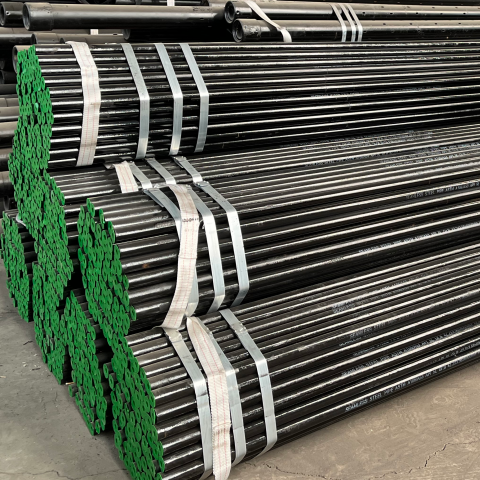 Cold Rolled Seamless Steel Pipe
 Mechanical Tube Size Chart
 ASTM A106 Seamless carbon steel pipe
 Insulated Steel Pipe Dimensions Chart

