

ASTM A106—Standard Specification for Seamless Carbon Steel Pipe for High Temperature Service
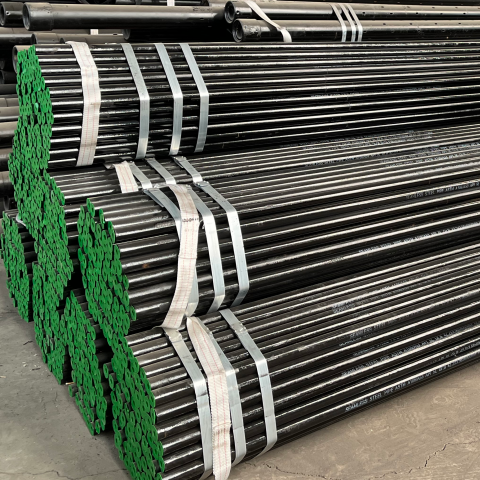
ASTM A106 Grade B seamless pipe
ASTM A106 Grade B seamless pipes (also known as ASME SA106 Grade B pipes) is a seamless carbon steel nominal pipe for high temperature use.
ASTM A106 Grade C seamless pipe
ASTM A106 Grade C seamless pipes (also known as ASME SA106 Grade C pipes) is a carbon-manganese steel pipe for high-temperature large-diameter boilers and superheaters. Its chemical composition is simple and similar to 20G carbon steel, but its carbon and manganese content is higher, so its yield strength is about 12% higher than that of 20G, and its plasticity and toughness are not bad. The steel has a simple production process and good cold and hot workability. Using it to replace 20G headers (economizer, water wall, low-temperature superheater and reheater header) can reduce the wall thickness by about 10%, which can save material costs, reduce welding workload, and improve headers The stress difference at start-up.
Chemical Composition of ASTM A106 Seamless Pipe:
| Steel Grade | C≤ | Mn | P≤ | S≤ | Si≥ | Cr≤ | Cu≤ | Mo≤ | Ni≤ | V≤ |
| A | 0.25 | 0.27-0.93 | 0.035 | 0.035 | 0.10 | 0.40 | 0.40 | 0.15 | 0.40 | 0.08 |
| B | 0.30 | 0.29-1.06 | 0.035 | 0.035 |
0.10 |
0.40 | 0.40 | 0.15 | 0.40 | 0.08 |
| C | 0.35 | 0.29-1.06 | 0.035 | 0.035 |
Note:
① For every 0.01% reduction in carbon content below the specified maximum carbon content, A106 seamless steel pipes are allowed to increase the manganese content by 0.06% above the specified maximum manganese content, but the maximum shall not exceed 1.35%;
②The sum of the five elements Cu, Ni, Cr, Mo, and V shall not exceed 1.00%
Mechanical Properties of ASTM A106 Seamless Pipe:
| Steel Grade | Tensile Strength(Mpa) | Yield Strength(Mpa) | Elongation(%) | Delivery Condition |
| A | ≥330 | ≥205 | 20 | Annealed |
| B | ≥415 | ≥240 | 20 | Annealed |
| C | ≥485 | ≥275 | 20 | Annealed |
ASTM A106 Seamless Pipe covers seamless carbon steel pipe for high-temperature service. These pipes are suitable for welding, bending, flanging, and similar forming operations. Mechanical testing of the specimens shall include tensile, bending, flattening, hydrostatic and nondestructive electric tests. Specimens undergoing bending tests shall consist of sections cut from a pipe. For flattening tests, the specimens shall be smooth on the ends and burr-free, except when made on crop ends. All tests shall be performed in room temperature. If any test specimen shows flaws it can be discarded and substituted for another test specimen. Before testing, if a specimen has scribe scratches, a retest shall be allowed. A retest shall also be allowed if a specimen breaks in an inside or outside surface flaw.
ASTM A106 (ASME SA106) seamless steel pipes & tubes can transport fluids or gases under high temperature and pressure. There are three grades: A, B, and C. The most commonly used ASTM A106 grade B is widely used in oil and natural gas refineries, power plants, petrochemical project factories, and boilers. and ship construction. These pipelines must carry fluids and gases that exhibit higher temperature and pressure levels Email : pipe@stpipefitting.cn.
 Cold Rolled Seamless Steel Pipe
 What Is The Difference Between Stainless Steel 304 VS 201?
 Mechanical Tube Size Chart
 Insulated Steel Pipe Dimensions Chart

