

Seamless steel pipes are called "seamless" because of their integrated forming process of skew rolling piercing + rolling/drawing. However, it is precisely this high-temperature, large-deformation manufacturing process that makes fluctuations in geometric dimensions such as outer diameter, wall thickness, ovality, and curvature almost unavoidable. Tolerances are not "good enough"—they directly affect:
Pressure bearing safety: Excessive negative deviation in wall thickness -Reduced actual pressure bearing capacity -Risk of pipe burst
Assembly and interchangeability: Out-of-tolerance outer diameter -Flange cannot be installed, expansion joint seals fail
Cost control: Blindly pursuing high precision = unnecessary processing costs and scrap rates; allowing deviations = on-site rework or even rejection of the entire batch
In short: Tolerance issues are not only standards compliance issues, but also issues of engineering consequences.
What Are Seamless Pipe Tolerances?
Pipe tolerance refers to the allowable deviation between the actual pipe dimensions and the standard specified dimensions. These deviations usually include:
Outside diameter (OD) tolerance
Wall thickness tolerance
Length tolerance
Straightness tolerance
Ovality tolerance
Weight tolerance
Because seamless pipes are manufactured through hot rolling, cold drawing, or extrusion processes, small dimensional variations naturally occur during production.
International standards such as ASTM, ASME, API, and EN define the acceptable tolerance ranges for different pipe grades and applications.
Dimensional tolerances:
| Pipe Types | Diameter(D) | Wall thickness(S) | ||
| Outer diameter of steel pipe(mm) | Permissible deviation(mm) | Wall thickness of steel pipe(mm) | Permissible deviation(mm) | |
| Cold Drawn Pipe | >30~50 | ±0.3 | >3~20 | ±10% |
| Hot Rolled Pipe | >219~457 | ±1.0 | ≤20 | -10%,+12.5% |
| >20~40 | ±10% | |||
| >457~1066 | ±0.9 | >40~70 | -7%,+9% | |
| >70~120 | -6%,+8% |
|||
Hot-rolled tubes (such as GB/T 8162/8163) generally adhere to a tolerance of approximately ±12.5% (strict control of negative deviations); cold-drawn tubes can achieve absolute value control of ±10% or even stricter.
Ovality and Curvature – “Hidden Tolerances”
Many buyers only look at the ± value of the outer diameter, neglecting two equally critical indicators:
Ovality (max OD − min OD of the same cross-section): Typically required to be ≤ 80% (standard) ~ 50% (high-grade) of the outer diameter tolerance zone; precision grade can require ≤ 0.05mm.
Curvature: ≤ 1.5mm per meter for standard pipes; ≤ 0.5mm/m for precision machinery pipes; length deviation for fixed-length pipes is typically 0~+20mm (precision grade) or 0~+50mm (normal grade).
Five Common Tolerance Issues in Seamless Steel Pipes:
1. Out-of-Tolerance Outer Diameter: An outer diameter that is too large or too small can prevent the assembly of flanges and valves, or cause poor sealing and flow restriction. This is particularly critical in high-pressure pipelines, boiler tubes, and API pipeline projects.
2. Uneven Wall Thickness (Eccentricity): Perforation or temperature runaway can cause uneven wall thickness, directly weakening the pressure-bearing capacity and easily leading to cracking, corrosion penetration, or pipe bursting.
3. Excessive Ovality: Out-of-roundness of the steel pipe cross-section often occurs during cooling, straightening, or transportation. This causes difficulties in automatic welding, reduced weld quality, and inaccurate alignment during on-site installation.
4. Length Deviation: Insufficient actual length of the specified pipe increases additional cutting costs, wastes materials, and delays the construction period. This problem is most common in large-diameter pipes.
5. Straightness (Bending): Bending of the pipe body caused by cooling or heat treatment severely affects CNC machining accuracy, pipe alignment, and structural stability. Even minor deviations can lead to the scrapping of precision workpieces.
A Comparative Study of International Standards for Seamless Steel Pipe Tolerances (Essential Reading for Procurement/Export)
| Standard System | Outer Diameter Tolerance (Typical) | Wall Thickness Control Requirements |
| ASTM A53 / A106 | ±1.0% OD, minimum ±0.50 mm | Minimum wall thickness at any point ≥ nominal wall thickness −12.5%; positive deviation usually limited by weight tolerance |
| API 5L (Line Pipe) | Similar to −12.5% minimum wall thickness control | Emphasizes that minimum wall thickness must not fall below 87.5% of specified value |
| EN 10216 (European Pressure Pipe Standard) | Classified by size table, starting from ±1.0% | Absolute and percentage mixed tolerances based on OD and wall thickness ranges |
| GB/T 17395 | D1–D4 four-level percentage tolerance system | S1–S5 five-level wall thickness system with optional non-standard customization |
The reason for the appearance of Seamless Pipe Tolerances
Excessive tolerances refer to the dimensions of the seamless steel pipe exceeding the standard range, including tolerances for wall thickness, outer diameter, and inner diameter. This can lead to unsatisfactory subsequent processing or use, affecting the final performance of the product.
Causes: Typically, this is due to lax production process control, particularly insufficient control of dimensional parameters during rolling, punching, or sizing. Alternatively, outdated or low-precision equipment may fail to meet the demands of high-precision processing, resulting in dimensions exceeding the standard range.
1. The Direct Root Cause of Deviations in Production Processes
The core cause of wall thickness tolerance deviations in seamless steel pipes lies in the hot rolling process. Uneven heating of the billet, coupled with the high fluidity of the metal in the high-temperature zone, easily leads to localized thinning. The piercing process is even more critical; misalignment of the rolls or wear of the mandrel directly results in an imbalance of stress on the steel pipe cross-section, forming "eccentric" or "internal hexagonal" defects.
2.Quality Control and Measurement Factors
Even with proper production and raw material control, inappropriate post-processing or measurement methods can "create" or amplify deviations. For example, improper parameters in the straightening process may alter the local wall thickness distribution. More importantly, the scientific nature of the measurement method and the accuracy of the instrument directly affect the reliability of the deviation data. Nan Steel not only uses a high-precision online thickness measurement system for real-time monitoring during production, but also employs ultrasonic thickness gauges for precise multi-point and multi-section measurements in the final inspection stage to ensure comprehensive and reliable data. Products exceeding tolerances are rigorously sorted to guarantee the consistency of outgoing products.
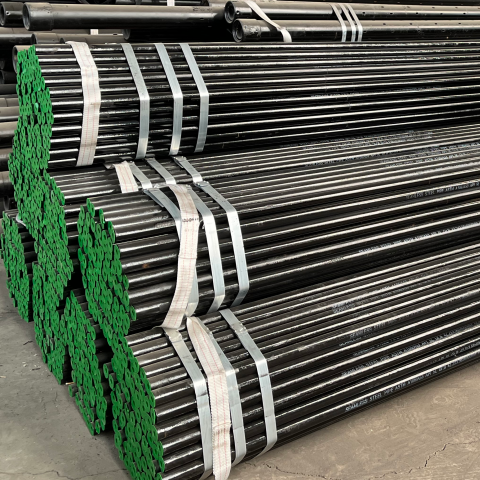 Cold Rolled Seamless Steel Pipe
 What Is The Difference Between Stainless Steel 304 VS 201?
 Mechanical Tube Size Chart
 ASTM A106 Seamless carbon steel pipe

